Guides  ›  Just thinking
Just thinking

Should I upgrade, or stay put?

A short, honest check before you spend your weekends at showflats.
By Jimmy Sum  |  CEA Reg No: R026725F  |  Updated November 2026
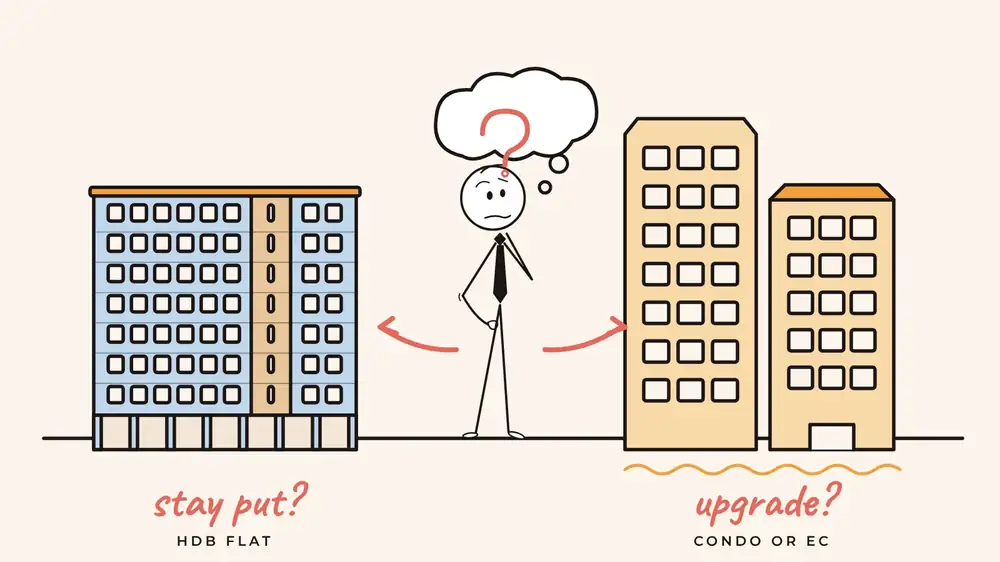
Line-art stickman thinking whether to stay in his HDB flat or upgrade to a condo, with an HDB block on the left and condo towers on the right
Stay in your HDB flat or upgrade to a condo? Start with your reason, then your numbers.

The short answer

Upgrading makes sense when three things line up: you have a clear reason, your numbers still work with a buffer, and the timing works for your household. If one of them is missing, staying put is not a failure. It is often the sensible choice, for now.

Start with your reason

Before any numbers, ask what you want to be different. Some reasons hold up well over time. Others tend to fade once the excitement of a showflat wears off.

Reasons that tend to hold up
  • Your household has grown, or will soon, and space is now a daily problem.
  • You are caring for a parent or child and need a different layout.
  • A move would make a real difference to your commute, or to a school you need.
  • You plan to stay in the next home for many years.
Reasons to pause on
  • Friends and neighbours are upgrading.
  • A launch looks good and you feel you might miss out.
  • Someone says prices will only go up.
  • You like the showflat, but cannot say what would change in your daily life.

A ten-minute self-check

Six statements. The more that are true for you, the closer you are to a decision you can live with.
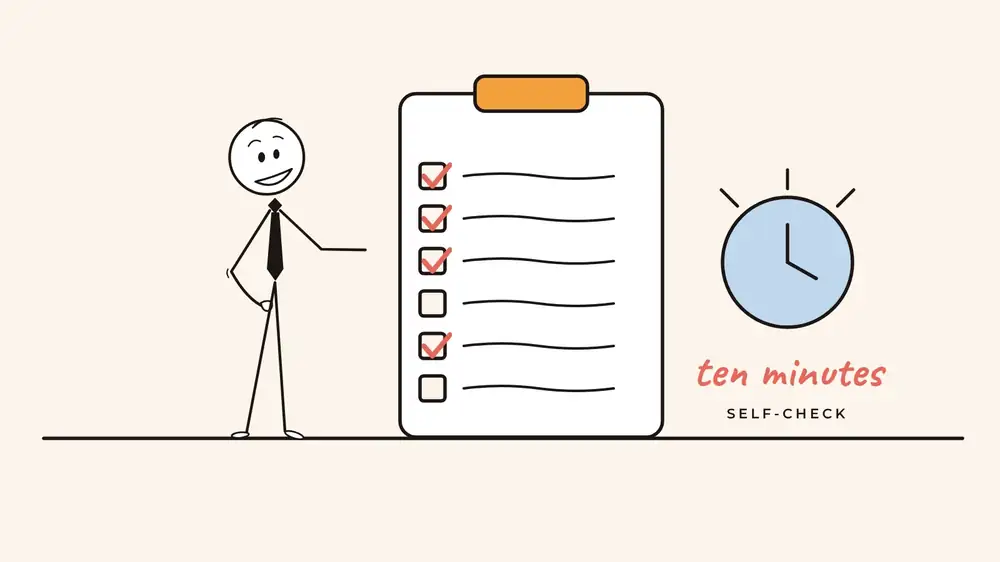
Line-art stickman pointing at a clipboard with a six-point checklist, four boxes ticked, next to a clock showing a ten-minute check
Six statements, about ten minutes. Be honest with yourself.

Try it

Tap each statement that is true for you
0 of 6 ticked
Probably not yet

Staying put and building more cash is a good result. Pick a date to review again, and use the worksheet to see how far you are.

This is a thinking aid, not an assessment. Nothing you tap is saved or sent.

What staying put can look like

Staying is a real option, not a pause on your life. Many households use the time well:
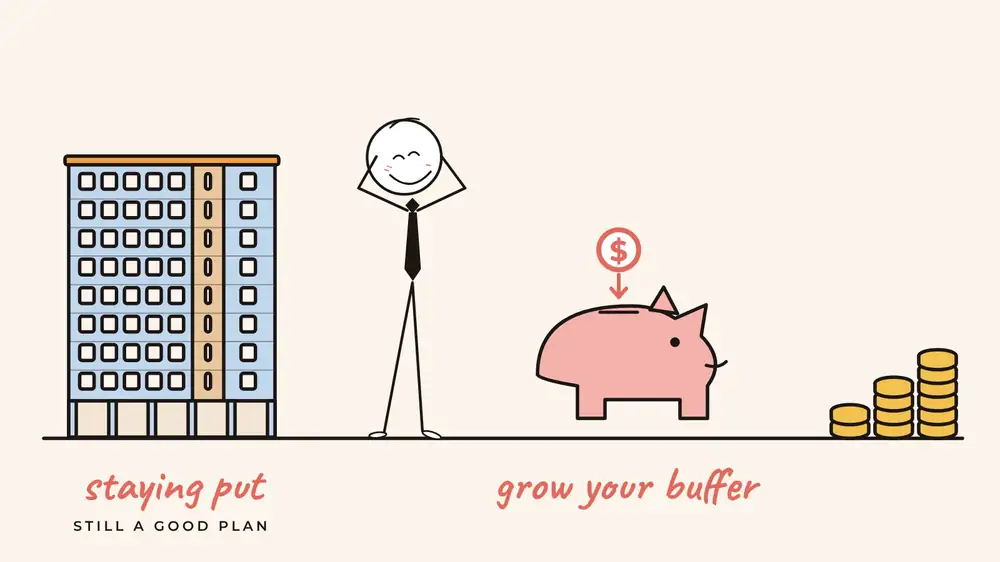
Line-art stickman relaxing next to his HDB block, with a piggy bank and growing stacks of coins showing a savings buffer building up
Staying put is a plan too, especially if you use the time to build your buffer.
  • Build your cash buffer. A bigger cushion makes any later move less risky.
  • Pay down other debts. Car loans and cards reduce how much a bank will lend.
  • Set a review date. Pick a month, such as when your MOP is reached, and look at your numbers again then.
  • Keep your CPF statement handy. Knowing your CPF used and accrued interest makes any future sale easier to plan.

What changes if you do upgrade

These are the points that surprise people most. Each one is covered in its own guide.

  • Your monthly cost is usually higher. That includes the loan, and maintenance fees for the condo’s facilities. See What changes when you move to private.
  • Less cash may come back than you expect. The CPF you used on your flat, plus the interest it would have earned, goes back to your CPF when you sell.
  • Timing is tight. Selling and buying rarely line up exactly, so you may need a plan for where you live in between. See Sell first or buy first?
  • Extra stamp duties can apply when you own a flat and buy another property. How they work depends on your timing, so check before you commit. An executive condo can be treated differently: see Condo or EC.
  • A bank checks your whole debt picture, not just the new loan.

Rules and rates change. Check current details with HDB, CPF Board, IRAS, MAS and your bank before you decide.

Two households, two answers

The same questions, with different numbers. These are made-up examples to show how the maths works, not real clients.

Illustrative

Couple A

Looking at a $1,500,000 condo. HDB sold for $680,000.

1. Cash from selling your HDB
Sale price$680,000
Assumed price, based on similar flats nearby.
Less HDB loan−$120,000
Outstanding loan, repaid to HDB.
Less CPF used and interest−$180,000
$150,000 used plus $30,000 accrued interest. Goes back to your CPF, not into your bank.
Less agent fee−$13,600
2% of the sale price, for illustration.
Cash from the sale$366,400
680,000 − 120,000 − 180,000 − 13,600. Your own savings are not counted.
2. Cash needed for the $1.5m condo
Minimum cash down payment−$75,000
5% of $1,500,000. This part must be paid in cash. The bank lends 75% of the price.
Buyer’s stamp duty−$44,600
Calculated on $1,500,000 using the buyer’s stamp duty tiers.
Legal fee (estimated)−$3,000
Estimate only.
Renovation, furnishing, moving−$80,000
Assumed budget.
Rent during a 3-month gap−$9,000
3 months at $3,000, between selling and moving in.
Rest of the down payment, paid in cash−$100,000
The rest of the down payment is $300,000 (20% of the price). CPF of $200,000 ($20,000 own CPF plus $180,000 returned) covers part of it. CPF can also pay stamp duty, but here all of it goes to this balance, so the stamp duty above is paid in cash. The remaining $100,000 comes from the cash from the sale.
Total cash needed−$311,600
75,000 + 44,600 + 3,000 + 80,000 + 9,000 + 100,000
Cash left from the sale$54,800
366,400 − 311,600. The sale covers the upgrade without touching your savings.
3. Can the monthly budget cope?
Take-home income$14,000
Both of you, after CPF.
Other commitments−$3,000
Car, insurance, parents, childcare.
Loan instalment at a rate 1% higher−$5,700
$1,125,000 loan over 30 years at 4.5%. Today’s 3.5% would be about $5,050.
Monthly left at a rate 1% higher$5,300
14,000 − 3,000 − 5,700. Interest rates can rise, so we test the budget at a higher rate.
Comfortable on paper. The sale alone covers the upgrade with about $54,800 to spare, and the monthly budget has a healthy buffer. The next step is the bank’s loan assessment.
Illustrative

Couple B

Looking at a $1,300,000 condo. HDB sold for $600,000.

1. Cash from selling your HDB
Sale price$600,000
Assumed price, based on similar flats nearby.
Less HDB loan−$150,000
Outstanding loan, repaid to HDB.
Less CPF used and interest−$210,000
Goes back to your CPF, not into your bank.
Less agent fee−$12,000
2% of the sale price, for illustration.
Cash from the sale$228,000
600,000 − 150,000 − 210,000 − 12,000. Your own savings are not counted.
2. Cash needed for the $1.3m condo
Minimum cash down payment−$65,000
5% of $1,300,000. This part must be paid in cash. The bank lends 75% of the price.
Buyer’s stamp duty−$36,600
Calculated on $1,300,000 using the buyer’s stamp duty tiers.
Legal fee (estimated)−$3,000
Estimate only.
Renovation, furnishing, moving−$60,000
Assumed budget.
Rent during a 3-month gap−$7,500
3 months at $2,500.
Rest of the down payment, paid in cash−$35,000
The rest of the down payment is $260,000 (20% of the price). CPF of $225,000 ($15,000 own CPF plus $210,000 returned) covers most of it, leaving $35,000 in cash. The stamp duty above is paid in cash because the CPF is used up here.
Total cash needed−$207,100
65,000 + 36,600 + 3,000 + 60,000 + 7,500 + 35,000
Cash left from the sale$20,900
228,000 − 207,100. Thin, with no allowance for surprises.
3. Can the monthly budget cope?
Take-home income$8,000
Both of you, after CPF.
Other commitments−$3,400
Car, insurance, parents, childcare.
Loan instalment at a rate 1% higher−$4,940
$975,000 loan over 30 years at 4.5%. Today’s 3.5% would be about $4,380.
Monthly left at a rate 1% higher−$340
8,000 − 3,400 − 4,940. A negative number means a monthly shortfall.
Too tight. Only $20,900 of the sale cash is left, and the monthly budget turns negative if rates rise. Staying put and building cash for another year or two may be the better move.

Notice the CPF line. The CPF you used on your flat, plus interest, goes back to your CPF account when you sell. It does not become cash in hand. That is why selling a flat for $680,000 does not leave $680,000 to spend.

Illustrative numbers only, in the same format as the free worksheet. Every figure above is assumed for illustration, and the loan instalments use a 30-year term. Your own figures will differ, so use your bank’s quote and your CPF statement.

What these numbers can’t tell you

The tables above assume a sale price, a loan and an interest rate. Your own answer depends on three things I can check with you:

  1. What your flat would realistically sell for today.
  2. What a bank would actually lend you, and what must be paid in cash.
  3. Whether your MOP date and your move-in timing work together.

How I look at it

Start with what you will have left

Most people start by asking what their flat is worth. I would ask a different question first: what will I have left? After the loan is repaid, your CPF goes back to your CPF account, and the fees are paid, the cash in your hand is often much less than the sale price suggests.

Then I would test the plan for a bad year, not a good one. A slightly higher interest rate, a renovation that costs more than quoted, or a few months between homes should not break it. If the plan only works when everything goes right, it is not ready.

And if the numbers say wait, that is useful information too. A year spent building cash and clearing debts can put you in a stronger position, with a clearer idea of what you want. Upgrading well matters more than upgrading quickly.

Quick answers

Common questions

There is no single right time. It is when you have a clear reason, your numbers still work with a buffer, and the timing suits your household. The Minimum Occupation Period (MOP) is usually 5 years for most flats, with longer periods for some flat types, and it is the earliest you can sell. Passing it does not mean you have to move. The MOP is counted from the date you collected the keys to your flat, and HDB lists it for each type of flat on the linked page. If you are unsure, ask HDB or me.

Next step

Put real numbers on your answer

Whether you lean towards upgrading or staying, the next step is the same: see what you would walk away with, and whether the monthly payment still fits.

Try the free worksheet Talk it through on WhatsApp
This guide is general information for HDB owners and is not financial, legal or tax advice. Figures and examples are illustrative only.
Jimmy Sum

A real estate professional helping Singapore HDB owners work out their numbers before they upgrade to a condo or EC.

WhatsApp me
Jimmy Sum | CEA Reg No: R026725F | ERA Realty Network Pte Ltd | Licence No. L3002382K
This website is run by a property agent and is not the website of any developer. Project images are artist's impressions. Figures and examples are illustrative only and are not financial advice.
© Jimmy Sum · Privacy · Disclaimer