How much cash do you really need?
The bank decides how much it will lend. The cash is whatever is left, so work it out from the price.
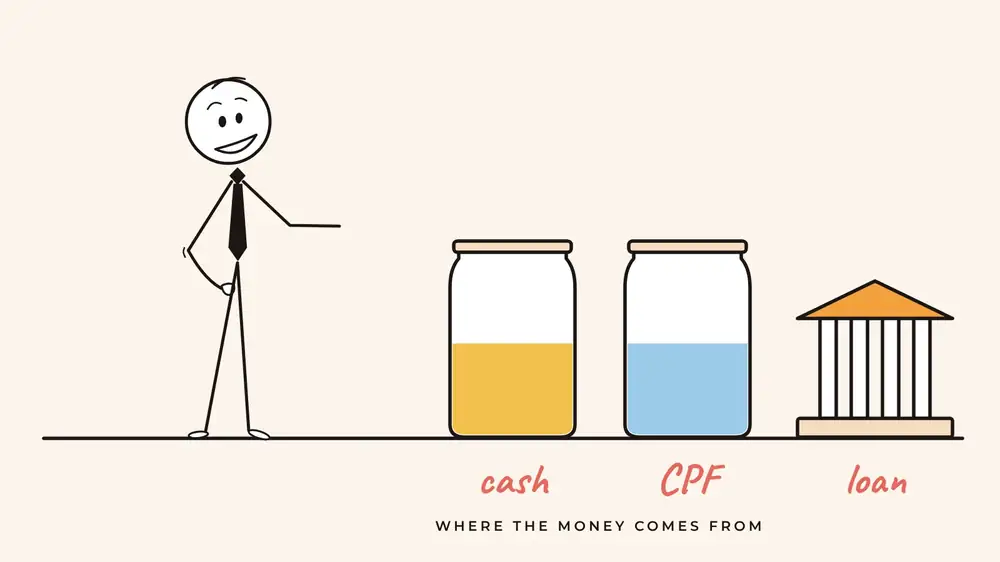
Start from the rules, not from your savings
Most HDB owners ask, “Do I have enough savings?” A better first question is how much the bank is allowed to lend you. Bank loans for private homes are capped as a share of the price, and part of what is left must be paid in cash, not CPF.
The twist for upgraders is that the cap depends on whether you still have a housing loan when you take the new one. Pick the case that fits you below.
Why the rules work this way
Banks lend against the home, and the rules are set so that buyers always put in some real money of their own. Two limits do the work.
The most the bank may lend, as a share of the price or valuation, whichever is lower.
For a first bank loan on a private home it is 75%. If you already have a housing loan running, the cap drops to 45%.
A part of your down payment must be cash. You cannot cover it with CPF.
It is 5% of the price on a first loan, and 25% when the 45% cap applies.
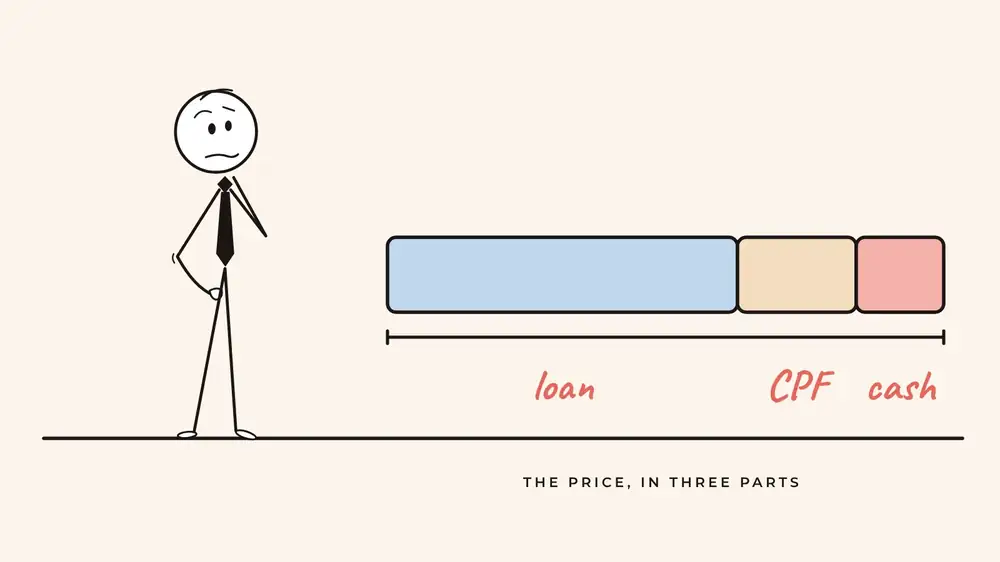
Once the loan and the minimum cash are fixed, the remaining part of the price can come from CPF, cash, or both. That balance is where most upgraders have room to move.
Whether your HDB loan counts as a running housing loan on the day you take the new loan depends on your timing, and your bank will check it. This is one of the biggest reasons the order of selling and buying matters.
Your cash, step by step
Try it
Rule used: loan up to 75% of the price, at least 5% in cash, and the next 20% in cash or CPF.
Fill in the boxes, or tap the example numbers.
Illustrative only. Rules as at November 2026: confirm the loan limits with your bank and the stamp duty with IRAS. Legal and other fees are not included. Nothing you type is saved or sent.
Where your HDB sale money actually goes
Many upgraders count their sale price as cash. It is not. It is paid out in a fixed order, and what reaches your bank account is usually much smaller.
If you buy before you sell, your HDB loan is still running, so the new loan may count as a second loan with a lower limit and more cash required. Selling first can change that, but it brings its own gap to plan for.
Read the sell-first or buy-first guide before you commit.
A worked example, start to finish
Here is a made-up couple. They sell their flat, then buy a $1.5m condo with a first loan. Every figure is illustrative.
Now the purchase.
After selling, the couple hold $351,500 in cash proceeds. The $280,000 CPF refund goes back into their CPF account and pays most of the 20% balance, so only $20,000 of it comes from cash. They need $232,600 in cash, which leaves about $118,900 to spare.
Not every couple has a CPF refund this large. With less CPF, more of the 20% has to be paid in cash and the gap can turn into a shortfall. That is why you start with the cash and not with the sale price.
Five ways people come up short
Do not forget the extras
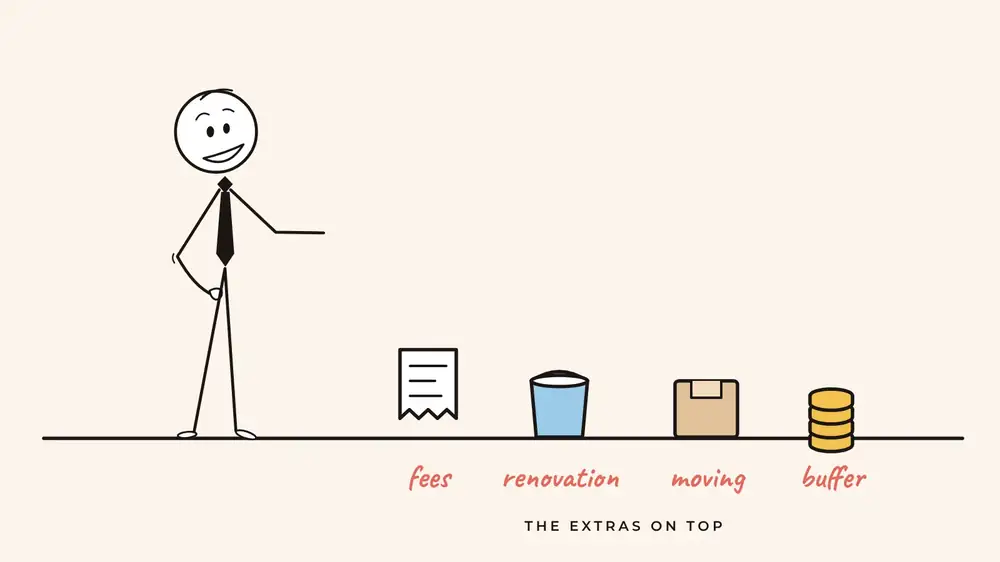
The tool above only includes stamp duty, renovation, moving and a buffer. Legal fees, valuation and furnishing come on top. The costs guide lists each one.
Read: Costs people forgetIf the cash is short
Look at a lower price, or an older or smaller home.
Give yourself more months to save.
Trim the renovation, and do it in stages.
Ask whether an executive condo fits, because its financing rules are different.
Check whether your timing could keep the loan cap higher.
Talk to your bank about the loan structure before you decide.
What these numbers can’t tell you
The example above is made up. Your own cash needed depends on three things I can work out with you:
- What your flat would realistically sell for, and what is left after your loan, CPF refund and selling costs.
- How much CPF you can use on your target price, and how much has to be paid in cash.
- Whether your cash covers the stamp duty, fees, renovation and a safety buffer.
Rules and rates change. Check current details with HDB, CPF Board, IRAS, MAS and your bank before you decide.
Related on this site
Next step
See your own cash gap
Send me your approximate price range and how much you expect from your sale, and I will help you work out where you stand.
A real estate professional helping Singapore HDB owners work out their numbers before they upgrade to a condo or EC.
WhatsApp me