Can I afford to upgrade from HDB to condo?
Three checks, in this order: your cash, your CPF and your monthly budget.
The short answer
You can afford an upgrade when three things hold at the same time: you have enough cash after the sale and all the costs, you use your CPF within its limits, and the monthly payment still leaves you room if a year goes badly. A bank saying yes is one input. It is not the whole answer.
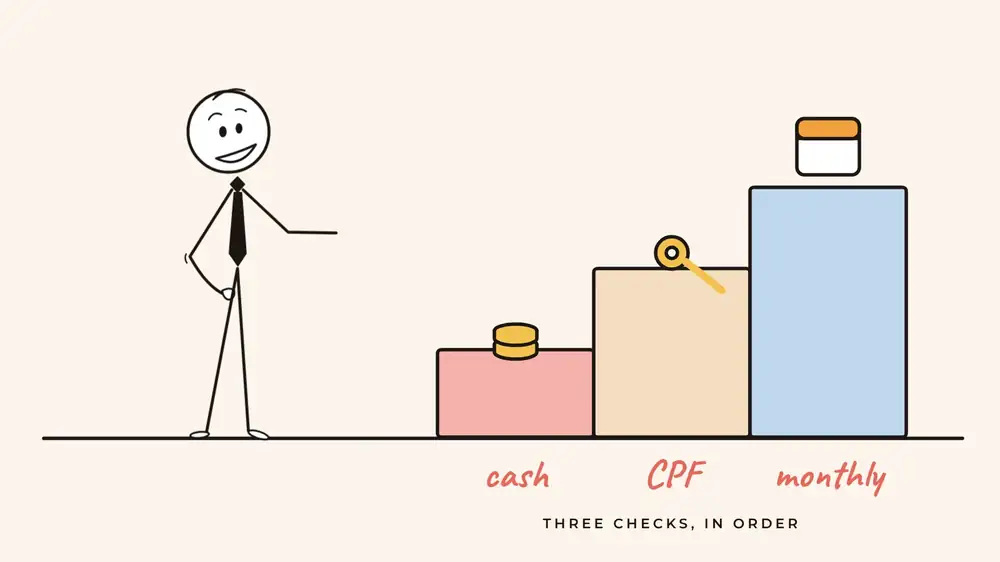
Three checks, in order
Do them in this order. Each one can change the answer to the next.
Check one: your cash
Cash is the part people most often overestimate. Look at what comes in, then what it has to cover.
- Savings you are happy to put in.
- Cash left from your sale, after your HDB loan is repaid and the CPF you used goes back to your CPF account.
- Cash gifts from family, if you have them.
- The part of the down payment that must be paid in cash.
- Stamp duties and legal fees.
- Renovation and moving.
- Rent or storage if you have a gap between homes.
- An emergency fund you are comfortable with.
Ask your bank how much of the down payment must be cash for the home you have in mind. It depends on the loan, so use a real figure from the bank when you can.
Put your own numbers in
A quick check on your cash and your monthly room. It is a thinking aid, not an approval.
Try it
Fill in the boxes, or tap the example numbers.
The numbers above are examples only. Use real figures when you can. Nothing you type is saved or sent. Banks apply their own limits on how much of your income can go to repayments, so the lower your share, the safer the plan.
Test it for a bad year
Do not test your plan on a good year. Try it with things going a little wrong:
- A higher interest rate. Your instalment may go up, so check you can still manage.
- A bigger renovation bill than the quote.
- A few months between homes, with rent or storage to pay.
- One income dips, or a new family member changes your costs.
If the plan only works when everything goes right, it is not ready yet. That is useful to know before you commit.
Common slips
- Counting the sale price as cash. After the loan, the CPF refund and the fees, the cash in hand is usually much smaller.
- Treating CPF as cash. CPF that goes back to your account stays in your account.
- Leaving out the buffer. A plan with no emergency fund has no room for surprises.
- Looking only at the instalment. Maintenance fees, property tax and utilities add to the monthly bill.
Rules and rates change. Check current details with HDB, CPF Board, IRAS, MAS and your bank before you decide.
How I look at it
Start with the gap, not the dream
I would not start with the price of the condo. I would start with the gap: how much money has to come from you, after the sale, the fees and the loan. Once that is clear, the rest of the plan has something solid to stand on.
Then I would ask how the plan feels in a tough year, not a good one. If a small rise in the rate or a surprise bill would upset it, we look again at the price, the timing, or both.
And if the numbers say wait, that is a fine answer. A few more months of saving can turn a tight plan into a comfortable one.
Quick answers
Common questions
Keep reading
More guides to read next
Related on this site
Next step
Check your own numbers
The worksheet starts with what your HDB sale leaves you, and the full version adds the down payment and the monthly budget. If you would like a second pair of eyes, I am happy to go through it with you.
A real estate professional helping Singapore HDB owners work out their numbers before they upgrade to a condo or EC.
WhatsApp me